Tiny light particles for brighter, morestable solar printed devices
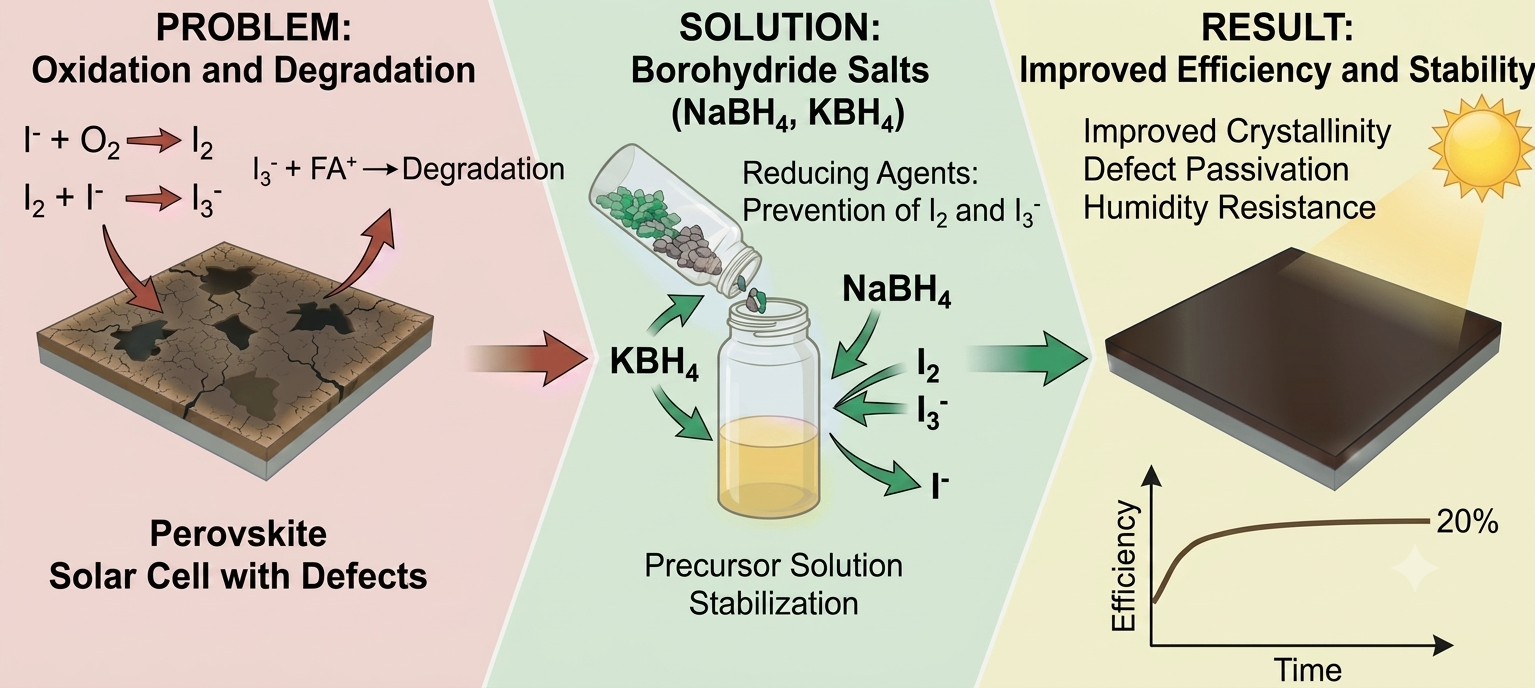
Halide perovskitematerials are often associated with next-generation solar cells, but theirpotential goes far beyond photovoltaics. As light absorption and light emissionare the sides of the same coin, they can also be efficiently used inlight-emitting technologies, including light emitting diodes (LEDs), displays,printed electronics and colour-converting devices.
A recentHEPAFLEX-supported study explores how very small perovskite particles, known asquantum dots, can be made more stable and easier to use in printedapplications. These particles are so small that they behave differently fromlarger materials. One of their most useful properties is that they can emitbright colours when exposed to light. By adjusting their composition,researchers can tune the colour they produce, including blue, green, red andeven white light, combining different colours.
Why does itmatter?
Forperovskite-based light technologies to move closer to real applications, theyneed to be stable, printable and reliable. This is still a challenge because halideperovskite quantum dots can be sensitive to water, heat, oxygen and light.These conditions can reduce their brightness and limit their use in practicaldevices.
Improving theirstability is therefore important for future printed and flexible technologies,such as displays, light-emitting surfaces, smart labels, sensors andcolour-converting LED components. It also supports the wider HEPAFLEX objectiveof advancing more sustainable, flexible and high-performance materials forfuture energy and solar applications.
What did theresearchers achieve?
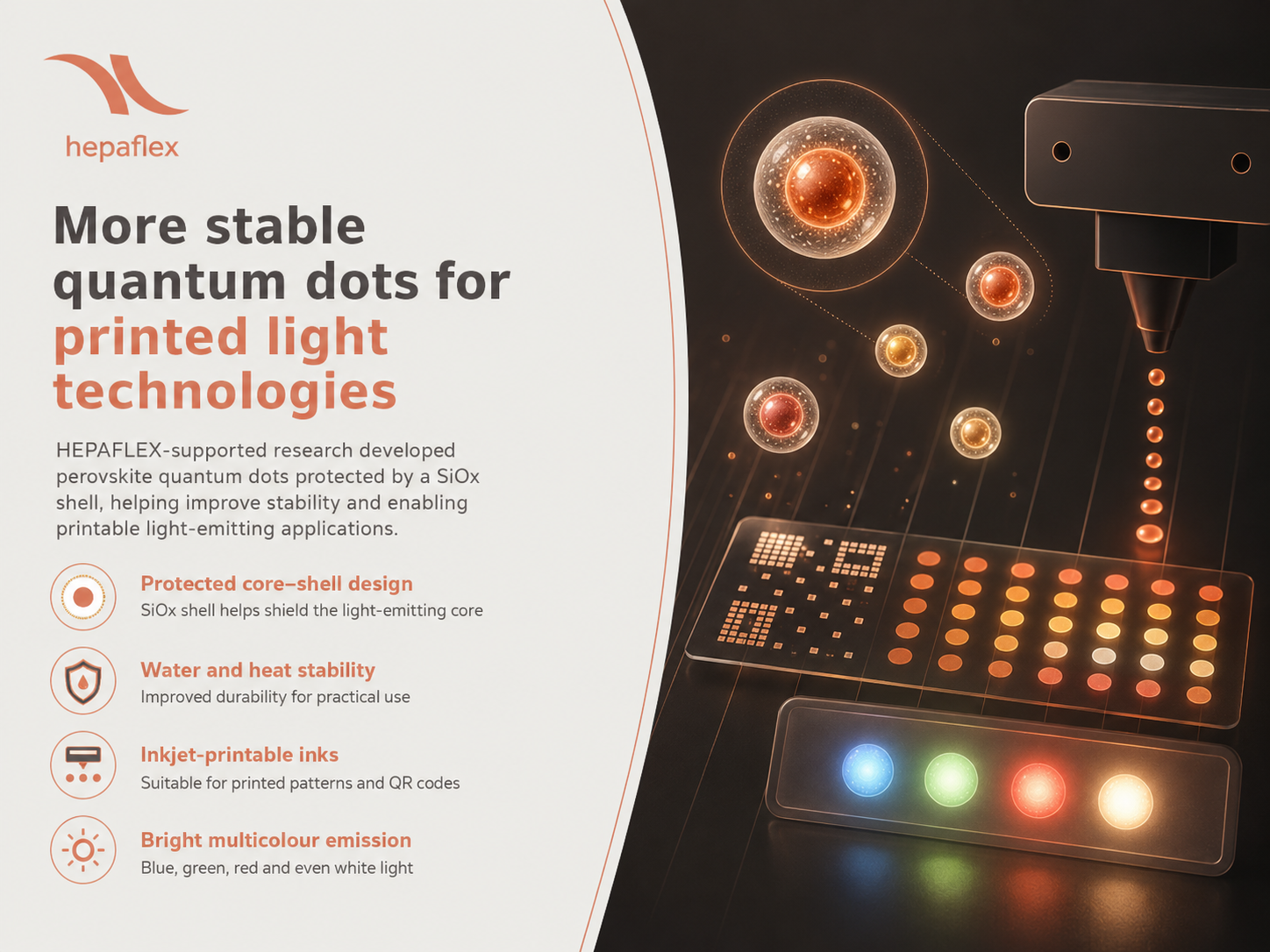
The researchteam developed perovskite quantum dots protected by a thin silicon oxide shell.This structure can be understood as a small light-emitting core surrounded by aprotective layer. The shell helps shield the material from external stress,improving its resistance to water and heat.
Thegreen-emitting quantum dots achieved a very high photoluminescence quantumyield of up to 99.4%, meaning that they were highly efficient at convertingabsorbed light into emitted light. The researchers were also able to tune theparticles to emit different colours by changing their composition.
The team thentransformed the quantum dots into printable inks. Using inkjet printing, theyproduced luminescent patterns, including QR codes, showing that the materialcan be processed using scalable printing techniques. The quantum dots were alsotested in colour-converting LED devices, where they produced blue, green, redand white light emission.
Who carriedout the research?
The study wasconducted by an international research team including scientists from YeungnamUniversity in the Republic of Korea, the Institute of Advanced Materials atUniversitat Jaume I in Spain, Universidad Austral de Chile, the University ofPardubice and Brno University of Technology in the Czech Republic, Ewha WomansUniversity, and Hanyang University ERICA. The work brought together expertisein materials chemistry, nanotechnology, optical characterisation, inkformulation and light-emitting devices.
Looking ahead
This researchshows that halide perovskite innovation is not limited to improving solarpanels. It can also contribute to future printed, flexible and light-emittingtechnologies.
The next stepswill include improving long-term stability, optimising device performance andexploring how these materials can be integrated into real-world optoelectronicapplications. If successful, this type of research could support thedevelopment of brighter, more adaptable and more sustainable printed lighttechnologies.
Source: S. Y. Park,G. Seo, T. Kim, et al. “ Thermal/Water-Stable CsPbX3@SiOxCore–Shell Quantum Dots for Inkjet Printing and Potential Color ConvertingApplications.” Adv. Optical Mater. 13, no. 29 (2025): e00968. https://doi.org/10.1002/adom.202500968

.png)