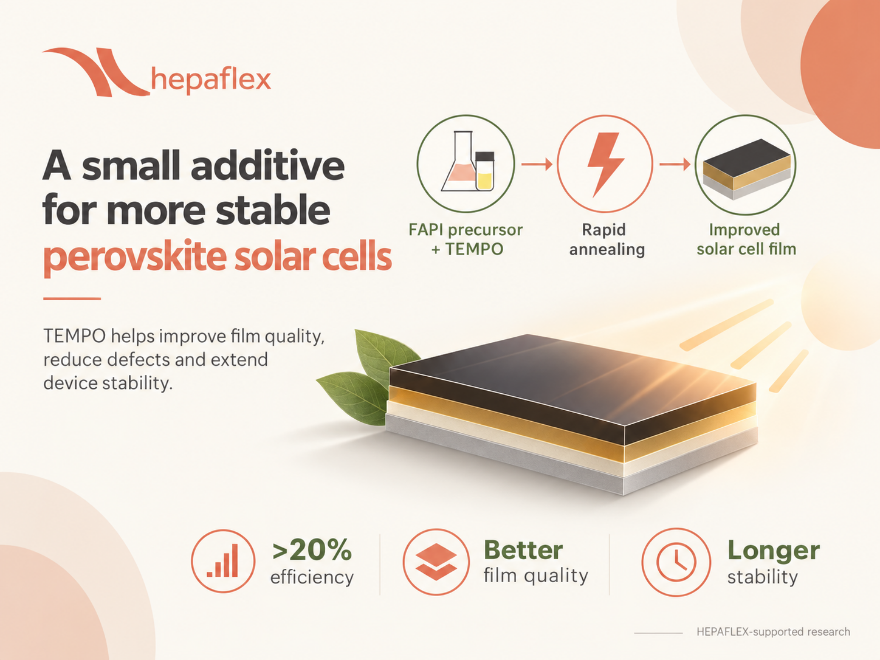
A greener route to more stable perovskite solar cells
Perovskite solar cells are one of the most promising technologies for the future of solar energy. They can be efficient, lightweight and potentially easier to manufacture than conventional silicon solar panels. However, many of the most advanced perovskite devices still face two important challenges: long-term stability and the use of hazardous chemicals during production.
A recent HEPAFLEX-supported study presents a simpler and greener way to produce a specific type of perovskite solar cell based on fully inorganic CsPbI₃. This material is interesting because it can offer better thermal stability than many hybrid perovskites and has properties that make it suitable for both outdoor solar energy generation and indoor energy harvesting.
Why does it matter?
Most high-performance perovskite solar cells are based on organic–inorganic materials. These can reach high efficiencies, but they may be sensitive to heat, moisture, light and other operating conditions. For solar technologies to move closer to real-world use, they need to remain stable over time and be produced through processes that are safer and more sustainable.
Fully inorganic perovskites, such as CsPbI₃, are an attractive alternative because they are more thermally stable. However, CsPbI₃ has its own challenge: the useful black phase of the material can be difficult to form and maintain. If the material changes into its yellow non-perovskite phase, it becomes much less useful for solar cells.
This is why improving the formation and stability of CsPbI₃ films is important. A simpler and cleaner synthesis route could help make perovskite solar cells more practical, scalable and environmentally responsible.
What did the researchers achieve?
The research team developed a new synthesis strategy by adding nickel acetate to the CsPbI₃ precursor solution. This additive helped guide the formation of the desired black perovskite phase and improved the crystallisation of the material.
The process uses one main solvent, DMSO (dimethyl sulfoxide), to prepare the solar-cell material. It also avoids several more harmful chemicals often used in other methods, such as DMF (dimethylformamide, a solvent with higher health and safety concerns), toluene and extra additives.
In simple terms, this makes the production process easier and helps reduce the use of chemicals that can be risky for people and the environment.
Using this approach, the researchers produced all-inorganic CsPbI₃ solar cells with power conversion efficiencies above 12% in standard outdoor-like testing conditions. The devices also showed promising operational stability, maintaining performance for more than 600 hours at maximum power point with less than 20% efficiency loss, without encapsulation and under a controlled inert atmosphere.
The study also explored indoor-light applications. Under low-intensity illumination, the devices achieved efficiencies above 15% under cool white light and above 17% under warm white light. This suggests potential for small devices that harvest energy indoors, for example from artificial lighting.
An environmental assessment was also carried out. The new synthesis route reduced the global warming potential by around 70% compared with the reference route and reduced impacts across most environmental categories. This is mainly because the process uses fewer materials, less energy and avoids several hazardous solvents and additives.
At the same time, the study is careful to note that some substances of concern remain, including lead iodide and nickel acetate in the absorbing layer. This means that further work is still needed to manage material safety, end-of-life handling and long-term environmental performance.
Who carried out the research?
The study was conducted by a research team affiliated with several research institutions, including the Instituto de Ciencia de los Materiales at the Universitat de València, Nanyang Technological University in Singapore, the Institute of Advanced Materials at Universitat Jaume I, École Polytechnique Fédérale de Lausanne, and the Instituto de Tecnología Química at Universitat Politècnica de València–CSIC.
Looking ahead
This research shows that greener chemistry and strong device performance can progress together. By simplifying the synthesis route and reducing the use of hazardous substances, the study contributes to the development of more sustainable perovskite solar technologies.
The next steps will involve further improving efficiency, testing long-term stability under real operating conditions, and addressing the remaining safety and environmental questions linked to lead-containing perovskites. If these challenges are properly managed, all-inorganic perovskites such as CsPbI₃ could become valuable materials for both outdoor photovoltaics and indoor energy harvesting.
Source: Jaume Noguera-Gómez, Víctor Sagra-Rodríguez, Marta Vallés-Pelarda, Miriam Minguez-Avellan, Sandy Sánchez, Rosario Vidal, Jaume-Adrià Alberola-Borràs, Rafael Abargues and Pablo P. Boix. Straightforward and green synthesis of all-inorganic CsPbI₃ perovskite solar cells via nickel acetate incorporation. EES Solar 2025, 1(5), 868–880. https://doi.org/10.1039/d5el00064e